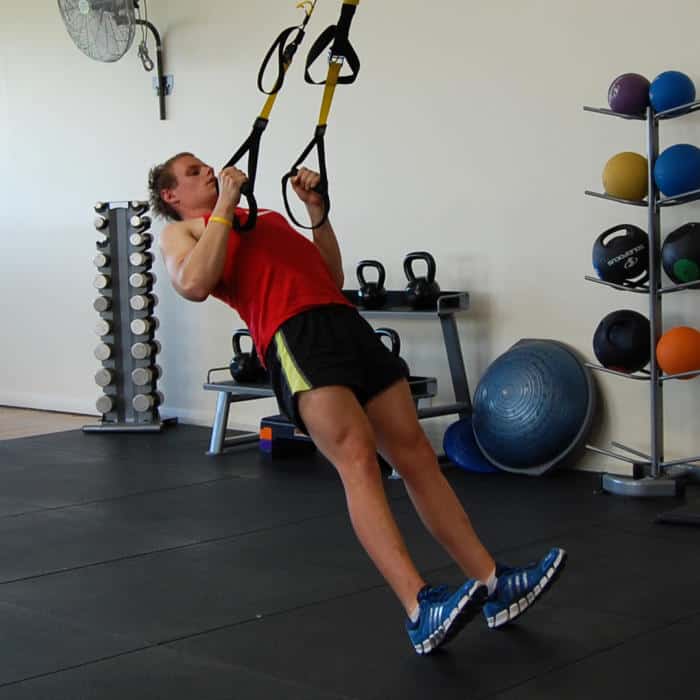
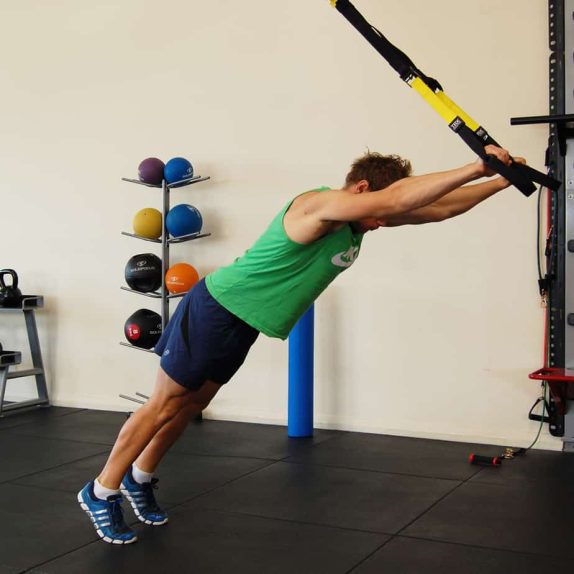
A strong core is the foundation of almost every TRX move you’ll ever do, and these TRX core exercises are built to train it the right way. Rather than bracing against a fixed, padded bench, suspension training keeps your whole midsection, obliques, deep stabilisers and all, working together just to keep you steady. That instability is exactly what makes it effective.
Fifteen to twenty minutes with a TRX Home2 Suspension Trainer, done consistently a few times a week, is enough to build noticeably stronger, more stable abs.
Why Train Your Core with a TRX Suspension Trainer?
A bench fixes your body against a stable, padded surface. A TRX Suspension Trainer does the opposite: the straps move with you, so your core has to fire constantly to keep your hips, shoulders and spine aligned. You end up training strength and stability in the same rep, which a fixed bench can’t replicate.
The straps also pack down small enough for a suitcase. The same TRX core exercises that work in a home gym work in a hotel room, a park, or a garage, anywhere you can anchor a door or a wall bracket.
The Benefits of TRX Core Training
Core training strengthens three muscle groups: the rectus abdominis (the “six-pack” muscle), the obliques (side rotation), and the transverse abdominis (deep spinal support). A stronger core delivers:
- Better posture and reduced lower back pain
- Improved balance and stability in everyday movement
- More efficient force transfer in every other lift, from rows to squats
- A more defined waistline with consistent training
Fifteen minutes of focused TRX core exercises, done consistently, is enough to see real change.
Warm Up First
Before loading your core, spend two to three minutes on hip circles, cat-cows, and a slow plank hold. TRX straps move the moment you load them, so your core needs to be switched on before the first rep, not during it.
1. TRX Suspended Knee Tuck
How to do it
- Adjust the straps to mid-calf length.
- Get into a plank with your feet in the foot cradles, hands under your shoulders.
- Keeping your back flat, drive both knees toward your chest, letting your hips lift.
- Pause, then extend back to plank with control.
Why it works
One movement trains your whole core. It combines a hip-flexion crunch with anti-extension plank work, hitting the rectus abdominis and hip flexors at the same time. It’s the TRX equivalent of the bench Reverse Crunch and Knee-to-Chest Crunch combined, and a natural place to start.
2. TRX Mountain Climber

How to do it
- From the same plank position, alternate driving one knee toward your chest at a time, keeping a fast but controlled tempo.
- Keep your hips level and avoid letting them pike upward.
Why it works
The alternating, faster tempo adds a conditioning element on top of the anti-rotation control from the Knee Tuck. Full step-by-step cues and coaching notes are in the TRX Mountain Climber exercise guide.
3. TRX Suspended Crunch
How to do it
- Lie on your back with your feet in the foot cradles, knees bent.
- Hands behind your head or crossed over your chest.
- Curl your head and shoulders up off the floor, keeping the straps steady.
- Lower with control.
Why it works
This is the direct TRX equivalent of a Bench Crunch. Elevating and suspending your feet adds instability the floor version doesn’t have, so your rectus abdominis works harder through the same range of motion.
4. TRX Bicycle Crunch
How to do it
- On your back, feet in the cradles, hands behind your head.
- Pull one knee toward your chest while twisting the opposite shoulder to meet it, extending the other leg straight.
- Alternate sides with control, avoiding momentum.
Why it works
Targets the obliques and rectus abdominis together for waistline definition. The strap resistance means each rep stays under tension instead of resting a foot on the floor between sides, unlike the bench version.
5. TRX Side Plank
How to do it
- Stand side-on to your anchor point and place one foot in a single foot cradle at hip height.
- Lower into a side plank, forearm or hand on the floor, hips lifted and stacked.
- Hold for time, then switch sides.
Why it works
Targets the obliques and hip stabilisers without loading the lower back. The elevated, moving foot makes this considerably harder than a floor side plank or the bench-based Copenhagen Plank it replaces.
6. TRX Standing Russian Twist
How to do it
- Hold both handles at chest height, lean back slightly, feet shoulder-width apart.
- Rotate your torso slowly from side to side, keeping your arms extended and core braced.
Why it works
Builds rotational strength through the obliques and transverse abdominis. Standing keeps this spine-friendly, a safer alternative to the decline-bench Russian Twist for anyone managing disc sensitivity.
7. TRX Flutter Kicks
How to do it
- On your back, feet in the cradles, legs straight, shoulders lifted slightly off the floor.
- Flutter your legs in small alternating kicks, keeping your lower back pressed down.
Why it works
Targets the lower abs and hip flexors. The straps keep constant tension on your legs throughout, where a floor version lets you rest between kicks.
8. TRX Body Saw with Crunch

How to do it
- From a forearm plank with feet in the cradles, rock your body forward and back in small, controlled movements.
- Add a crunch at the end of each rep for extra intensity.
Why it works
The most demanding move on this list. Full coaching cues are in the TRX Body Saw with Crunch exercise guide. Once the seven exercises above feel manageable, this is the natural progression.
Bonus progression: once Body Saw feels easy, move on to the TRX Anti-Extension Fallout, the most advanced anti-extension move in the library.
Sample TRX Core Circuit
Run through this circuit two to three times for a complete 15-20 minute core session:
| Exercise | Reps / Time | Rest |
|---|---|---|
| Suspended Knee Tuck | 12 reps | 15 sec |
| TRX Mountain Climber | 30 sec | 15 sec |
| Suspended Crunch | 15 reps | 15 sec |
| Bicycle Crunch | 30-45 sec | 15 sec |
| Side Plank | 30 sec per side | 15 sec |
| Standing Russian Twist | 30-45 sec | 15 sec |
| Flutter Kicks | 30 sec | 15 sec |
| Body Saw with Crunch | 30-45 sec | 30 sec |
Common Mistakes to Avoid
- Setting the straps too long or too short for the exercise (check the TRX Setup Calculator if you’re unsure)
- Letting your hips sag instead of keeping a flat, braced line
- Rushing the tempo instead of controlling each rep
- Holding your breath through the hardest reps
- Skipping the warm-up and loading a cold core straight away
Getting Set Up
All eight exercises need is a TRX Home2 Suspension Trainer and an anchor point. No ceiling beam at home? A Workout Door Anchor or Wall Mount Bracket gets you set up in any room in minutes. If you’re new to suspension training altogether, start with The Best TRX Exercises for Beginners before working through this list.
Final Thoughts
You don’t need a bench, a mat, or a full gym to build a stronger core. These eight TRX core exercises train your abs, obliques and deep stabilisers together, using nothing but a strap and an anchor point. Work through the circuit two to three times a week, focus on control over speed, and progress toward the Body Saw and Anti-Extension Fallout as your core strength builds.
Ready to train? Shop the TRX Home2 Suspension Trainer or browse the full TRX Exercise Library for more moves to add to your routine.