Strong forearms do more than improve your grip. They help with pulling strength, wrist stability, training control, and everyday tasks like lifting, carrying and holding onto equipment. If your grip gives out before the rest of your body does, forearm training may be the missing piece in your routine.
The good news is you do not need a full gym setup to work on it. With a TRX Suspension Trainer, a pair of dumbbells or even just your bodyweight, you can build stronger forearms from home.
Why Forearm Training Matters
Your forearms play a big role in almost every upper body session. Whether you are rowing, carrying shopping bags, doing pull movements or holding a plank, your forearms are constantly working in the background.
Building forearm strength can help you:
- improve grip endurance
- support stronger pulling exercises
- increase wrist stability
- improve control in functional training
- reduce weakness through the lower arm during workouts
If you train regularly but often feel your hands or wrists tiring early, adding a few forearm-focused movements each week can make a real difference.
How Often Should You Train Forearms?
For most people, training forearms 2 to 3 times per week is more than enough. Because these muscles are used often, they respond well to regular work, but they still need recovery. Leave at least a day between sessions if they are feeling overly fatigued. This follows the source guide’s general recommendation for frequency and recovery.
Warm Up First
Before starting, spend a few minutes warming up your wrists and hands. Simple wrist circles, open-and-close hand drills, and gentle forearm stretches can help get blood flowing and prepare the joints for loading.
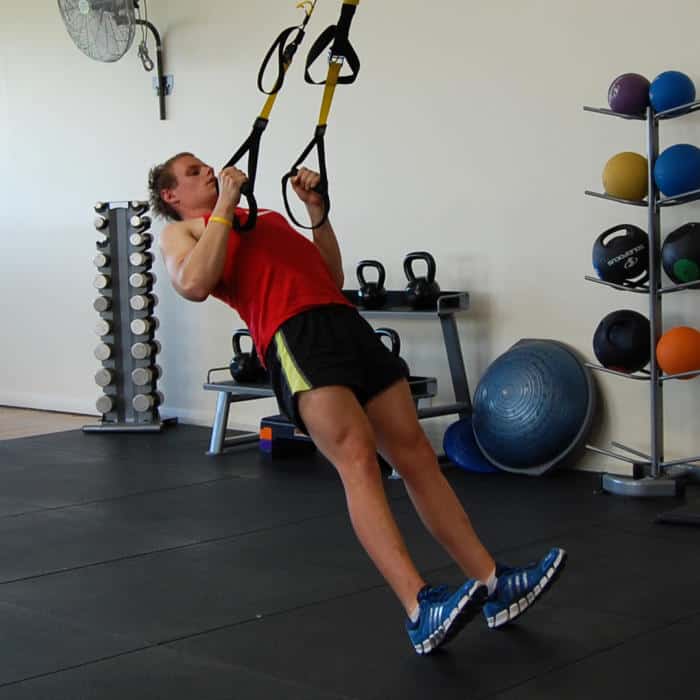
1. TRX Rows
TRX Rows are one of the best all-round movements for combining upper body training with grip and forearm engagement. Because the straps move freely, your hands and forearms have to work throughout the full set to maintain control.
How to do it
- Secure your TRX Suspension Trainer properly.
- Hold the handles and lean back with your body in a straight line.
- Keep your core engaged and chest lifted.
- Pull your body towards the handles by driving your elbows back.
- Squeeze at the top, then lower slowly with control.
Why it works
TRX Rows train your back, shoulders and arms, while also challenging grip endurance. They are a great place to start if you want forearm work that also delivers full upper body value.
2. Wrist Curls
Wrist curls are a simple but effective way to target the forearm flexors. These muscles are heavily involved in gripping, carrying and pulling.
How to do it
- Sit on a bench or chair.
- Rest your forearms on your thighs with your palms facing up.
- Hold a light dumbbell in each hand.
- Let your wrists drop slightly, then curl them upward.
- Lower slowly and repeat.
Why it works
This movement directly targets the muscles on the underside of the forearm and can help improve grip support in both training and daily tasks.
3. Reverse Wrist Curls
To build balanced forearms, it is important not to ignore the other side. Reverse wrist curls target the forearm extensors, which help support wrist control and joint balance.
How to do it
- Sit with your forearms resting on your thighs.
- Hold light dumbbells with palms facing down.
- Lower your wrists gently.
- Lift your knuckles upward using only your wrists.
- Return slowly and repeat.
Why it works
A lot of people overtrain gripping and undertrain the opposite side of the forearm. Reverse wrist curls help create better balance and can support healthier wrist and elbow function.
4. Farmer’s Carry
Farmer’s carries are one of the most practical forearm exercises you can do. They are simple, challenging and highly effective.
How to do it
- Stand tall with a dumbbell or kettlebell in each hand.
- Keep your shoulders back and core tight.
- Walk slowly and steadily while holding the weights.
- Continue until your grip begins to fail.
- Rest, then repeat.
Why it works
This exercise builds real-world grip strength, forearm endurance and overall body tension. It is especially useful if you want training that feels functional and transferable.
5. Fingertip Push-Ups or Elevated Finger Holds
If you want a bodyweight challenge, fingertip push-ups are a strong option for more advanced users. If they are too difficult, start with fingertip holds against a bench or wall.
How to do it
- Get into a push-up position.
- Support yourself on your fingertips instead of flat palms.
- Keep your body straight and controlled.
- Lower carefully if performing a push-up, or simply hold the top position.
- Start with short holds or reduced range if needed.
Why it works
This movement challenges the fingers, hands, wrists and forearms together. It is demanding, so begin carefully and progress slowly.
Sample Forearm Finisher
If you want to add forearm work onto the end of a workout, try this:
- TRX Rows: 3 sets of 10 to 12
- Wrist Curls: 3 sets of 15
- Reverse Wrist Curls: 3 sets of 15
- Farmer’s Carry: 3 rounds of 30 to 45 seconds
- Fingertip Holds: 2 to 3 rounds of 15 to 20 seconds
This gives you a simple combination of grip work, direct forearm loading and TRX-based functional strength.
Common Mistakes to Avoid
A few things can hold people back when training forearms:
- going too heavy too early
- rushing through the reps
- ignoring the extensor side of the forearm
- training grip to exhaustion right before major pulling sessions
- skipping wrist warm-ups
Focus on control first, then gradually build time, reps or load.
Final Thoughts
Forearm training does not need to be complicated. A few well-chosen movements each week can help improve grip, support upper body strength and make your workouts feel more complete. TRX Rows are especially useful because they let you train forearms in a more functional way while also building back and arm strength.
If you are looking for a simple way to train at home, a TRX Suspension Trainer gives you a versatile setup for rows, bodyweight strength and full-body conditioning, all while keeping your forearms working harder than many traditional machines or fixed exercises. The source article similarly highlights TRX rows, grip endurance, wrist work, carries, and warm-up/recovery as key parts of at-home forearm training.