
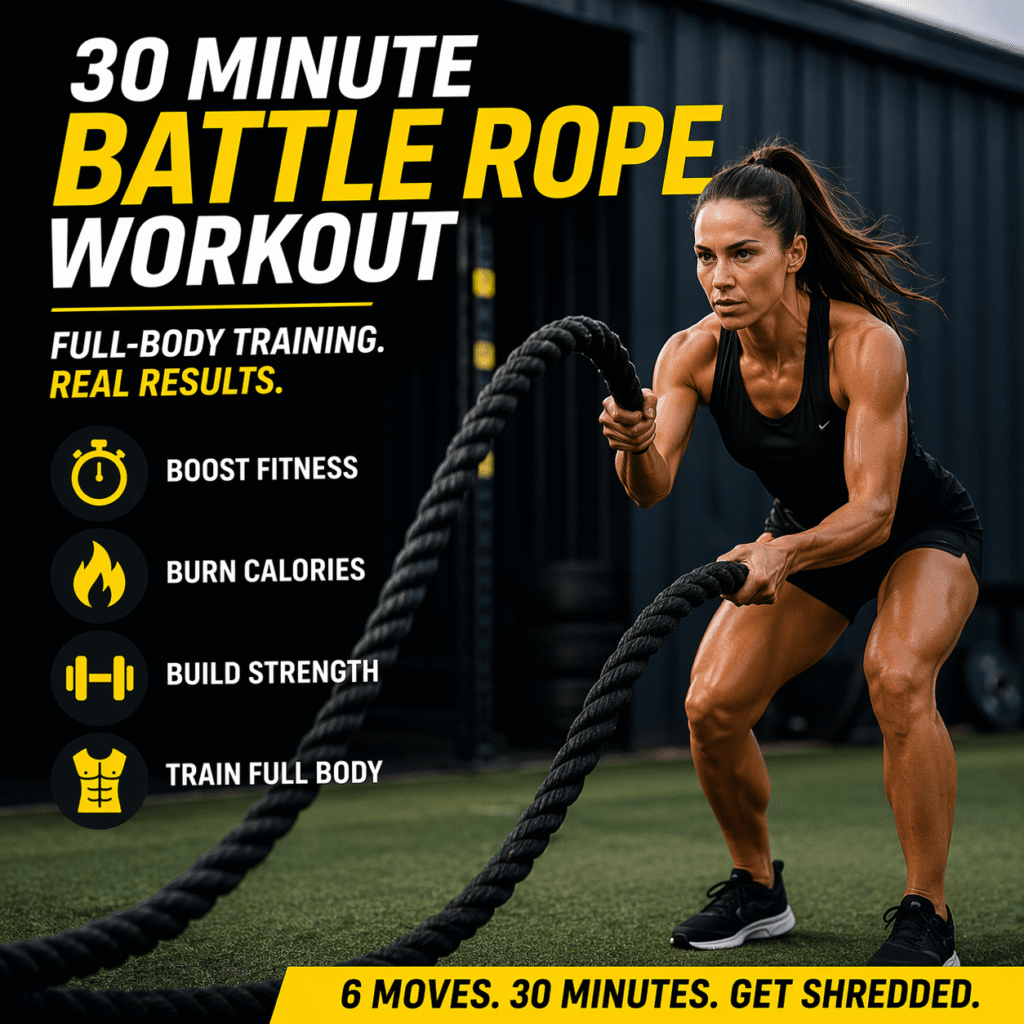
If you want a fast, intense workout that builds strength, lifts your heart rate and helps burn serious energy, battle ropes are a great option. A solid 30-minute battle rope session can challenge your upper body, core, legs and cardio all at once, making it a smart choice for anyone wanting efficient full-body training at home or in the gym.
In this guide, we’ll cover why battle ropes are so effective, how to get the most out of them, and a simple 30-minute workout you can add to your weekly training.
Why Train with Battle Ropes?
Battle ropes are one of the most effective tools for combining resistance training with conditioning. They look simple, but once you start using them properly, they quickly become a serious challenge.
Some of the main benefits of battle rope training include:
- improved muscular endurance
- stronger shoulders, arms and grip
- better core engagement
- increased cardiovascular fitness
- more coordination and body control
- a full-body workout in a short amount of time
They are also highly versatile. You can use them for short bursts, conditioning circuits, warm-ups, finishers or full training sessions.
Key Battle Rope Training Principles
To get the most value from battle rope training, it helps to focus on a few core principles.
Move with purpose
Do not just swing the ropes around for the sake of it. Every movement should be deliberate. Controlled reps help improve technique, build better muscle engagement and reduce the chance of injury.
Prioritise posture and control
Keep your chest up, core switched on and knees slightly bent. Good posture helps you generate power properly and protects your shoulders and lower back.
Train in different directions
Battle ropes are not just for up-and-down waves. Side-to-side patterns, slams, rotations and movement-based drills all challenge the body differently and create a more complete workout.
Use the whole body
Battle ropes work best when they are not treated as just an arm exercise. Your legs, core, shoulders and grip should all be involved. The more connected your movement is, the better the result.
Adjust the difficulty
You can change the challenge level by adjusting your rope thickness, rope length, body position, speed, work time and rest time. That makes battle ropes suitable for beginners through to advanced trainers.
30-Minute Battle Rope Workout
This workout combines strength, cardio and core work into one efficient session. You can perform each exercise for 40 seconds of work followed by 20 seconds of rest, then repeat the full circuit for 3 to 4 rounds depending on your fitness level.
1. Alternating Lunge Waves
This exercise combines lower-body control with upper-body endurance. It is a great way to build rhythm, coordination and full-body stability.
How to do it
- Stand tall holding one rope in each hand.
- Step forward into a lunge.
- As you lower into the lunge, keep the ropes moving in alternating waves.
- Push back to standing and repeat on the other side.
- Continue alternating legs while maintaining smooth rope movement.
Why it works
This movement challenges the legs, arms and core together while keeping your heart rate up.
2. Battle Rope Jacks
Battle Rope Jacks add a cardio element to rope training while still working the shoulders, arms and core.
How to do it
- Start with your feet together and a rope in each hand.
- Jump your feet out wide while lifting the ropes outward and upward.
- Jump your feet back together as the ropes return down.
- Keep the movement light, controlled and rhythmic.
Why it works
This is a strong conditioning exercise that builds endurance and gets the whole body moving.
3. Battle Rope Russian Twists
This variation targets the core, especially the obliques, while also working the shoulders and arms.
How to do it
- Sit on the floor with your knees bent.
- Hold the rope handles and lean back slightly.
- Twist through your torso to one side while moving the ropes across.
- Rotate to the other side and repeat.
- Keep your abs engaged the whole time.
Why it works
It adds rotational strength into your session, which is useful for sport, movement control and overall core development.
4. Plank Alternating Slams
This is a tougher variation that combines anti-rotation core work with explosive upper-body effort.
How to do it
- Start in a high plank position.
- Hold a rope in each hand.
- Slam one rope down while keeping your hips as steady as possible.
- Place that hand back in position and repeat on the other side.
- Alternate from side to side with control.
Why it works
It builds shoulder endurance, core stability and coordination, all while pushing your conditioning higher.
5. Bilateral Waves
This is one of the classic battle rope movements and a great place to build consistency and endurance.
How to do it
- Stand with your feet shoulder-width apart.
- Hold a rope in each hand.
- Move both arms up and down at the same time to create even waves.
- Keep your knees soft and core engaged.
- Focus on producing smooth, powerful movement.
Why it works
Bilateral waves build shoulder endurance, grip strength and conditioning while teaching good rope rhythm.
6. Rainbow Slams
Rainbow Slams add a rotational element and force production through the whole body.
How to do it
- Stand tall with a rope in each hand.
- Lift both ropes up and over to one side.
- Slam them down in a sweeping arc.
- Bring them back up and repeat to the other side.
- Continue alternating with control and power.
Why it works
This movement develops rotational strength, shoulder power, coordination and total-body explosiveness.
Battle Rope Workout Tips
To get better results from your battle rope training, keep these points in mind.
Nail your technique first
Good form matters more than speed. Learn how to create clean waves and controlled slams before trying to go faster.
Vary your movements
Mixing waves, slams, side patterns and dynamic drills will challenge different muscle groups and stop your sessions becoming repetitive.
Use the right rope for your level
Longer or thicker ropes usually feel more demanding. Beginners may be better off starting with a rope that allows good technique and manageable work intervals.
Use battle ropes as a finisher
If you do not want a full rope session, they also work well at the end of a weights or functional training workout.
Keep your core engaged
A strong core helps transfer force and keeps your body stable during each movement.
Watch your shoulder position
Avoid shrugging your shoulders up. Keep them set and controlled to reduce tension and improve movement quality.
Breathe properly
Do not hold your breath through hard intervals. Controlled breathing will help you maintain output and recover better between rounds.
Get guidance if needed
If you are new to battle ropes, a coach, trainer or clear instructional content can help you improve faster and avoid bad habits.
Final Thoughts
Battle ropes are an excellent tool for anyone wanting a challenging, efficient and versatile workout. They can build strength, improve endurance, raise fitness levels and add variety to your training without needing a large setup.
Whether you use them for a 10-minute finisher or a full 30-minute conditioning session, battle ropes can deliver serious results when used properly. If you are setting up a home gym or upgrading your training space, adding a quality battle rope is a smart move for full-body conditioning.
Suspension training in Australia
Suspension Exercise is the Australian home of TRX suspension trainers, wall mounts, resistance bands and structured training programs, shipped Australia-wide from our store in Hunters Hill, Sydney. Every price is shown in Australian dollars and you can also visit the TRX store in Hunters Hill. Browse the TRX range for Australia or plan your next session with the free TRX calculators.


